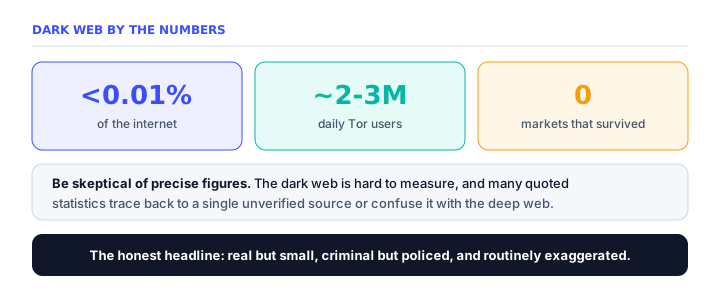
The grounded dark web statistics: it's well under 0.01% of the internet (the '90%' figure describes the deep web), the Tor network has a few million daily users worldwide (most browsing the ordinary web privately), and zero major markets have survived long-term. Be skeptical of precise, dramatic figures — the dark web is hard to measure and many quoted stats trace to a single unverified source.
- The dark web is under 0.01% of the internet
- The “90%+” figure describes the deep web, not the dark web
- Tor has a few million daily users, mostly on the ordinary web
- Zero major markets have survived long-term
- Distrust precise, dramatic figures — it's hard to measure
Dark web statistics are quoted constantly — in articles, ads, and security pitches — and a striking number of them are wrong, unsourced, or confuse the dark web with the deep web. Here are the figures worth knowing, the ones to distrust, and how to tell them apart.
The grounded figures
- Size: the dark web is a tiny fraction of the internet — well under 0.01%. The “90%+” figure people cite describes the deep web (ordinary logged-in content), not the dark web.
- Users: the Tor network has on the order of a few million daily users worldwide — and most use it to browse the ordinary web privately, not the dark web.
- Markets: the number of major marketplaces that have survived long-term is zero. Every one has been seized or exit-scammed.
- Content mix: a substantial share of onion services are legitimate or mundane; the criminal portion is real but a policed minority.
The statistics to distrust
Be skeptical of any precise, dramatic figure — “X% of the dark web is illegal,” “the dark web is N times bigger than the surface web.” The dark web is genuinely hard to measure, many quoted stats trace to a single unverified study, and some come from companies selling monitoring who benefit from alarm. For instance, the often repeated claim that the deep web is 400–550 times larger than the surface web comes from a 2001 study of public web content, not a live count of .onion sites. Likewise, the assertion that more than half of Tor sites are illegal is typically based on a 2016 academic crawl of a few thousand onion services, not a full census of Tor traffic. Because hidden services appear and disappear, directories change, and many sites require authentication or are not linked, any single percentage should be treated as a rough snapshot rather than a definitive statistic.
Why it's hard to measure
The dark web resists measurement by design. Onion sites hide, go offline constantly, and block crawlers, so any count is a partial snapshot of a moving target. “How big” and “how much is illegal” have no precise, stable answer — which is exactly why confident-sounding percentages should raise suspicion.
The honest headline
Stripped of hype, the statistical picture is consistent: the dark web is real but small, criminal in part but policed, home to legitimate uses more often than its reputation suggests, and surrounded by numbers that are routinely exaggerated. When you see a dramatic dark web statistic, ask where it came from — the answer is often “nowhere verifiable.”
Frequently asked questions
How big is the dark web?
Well under 0.01% of the internet — a tiny fraction. The ‘90%+’ figure people cite actually describes the deep web (ordinary logged-in content like email and banking), not the dark web, which is small and separate.
How many people use the dark web?
The Tor network has on the order of a few million daily users worldwide, but most use it to browse the ordinary web privately rather than the dark web itself. Precise dark-web-specific user counts are unreliable.
What percentage of the dark web is illegal?
There's no reliable precise figure — the dark web is hard to measure, and confident percentages should be distrusted. There's a real criminal element, but also substantial legitimate and mundane content; the criminal portion is a policed minority.
Why should I distrust dark web statistics?
Because the dark web is genuinely hard to measure, many quoted figures trace to a single unverified study, some confuse it with the deep web, and some come from companies selling monitoring who benefit from alarm.
Is the dark web bigger than the surface web?
No. The dark web is a tiny fraction of the internet. Claims that it dwarfs the surface web confuse it with the deep web — the ordinary logged-in content that genuinely is most of the internet.